Master Guide: Navigating the GHG Protocol for Corporate Carbon Accounting
2026-01-15 · By Anil Kancharla · 6 min read
❤️ 3 Likes · 👁️ 0 Views
 AI-generated image for illustration purposes only.
Systems Thinking 101: Why You Can’t Solve Emissions in a Silo
 AI-generated image for illustration purposes only.
Master Guide: Navigating the GHG Protocol for Corporate Carbon Accounting
In an era where environmental, social, and governance (ESG) performance dictates market value and consumer trust, carbon accounting has transitioned from a niche "green" initiative to a fundamental business requirement. For organizations aiming to manage their climate impact, the GHG Protocol Corporate Standard is the gold primary framework.
This comprehensive guide breaks down the complexities of Greenhouse Gas (GHG) inventories, from selecting your base year to rolling up data for global corporate reporting.
1. Understanding the GHG Protocol Standard
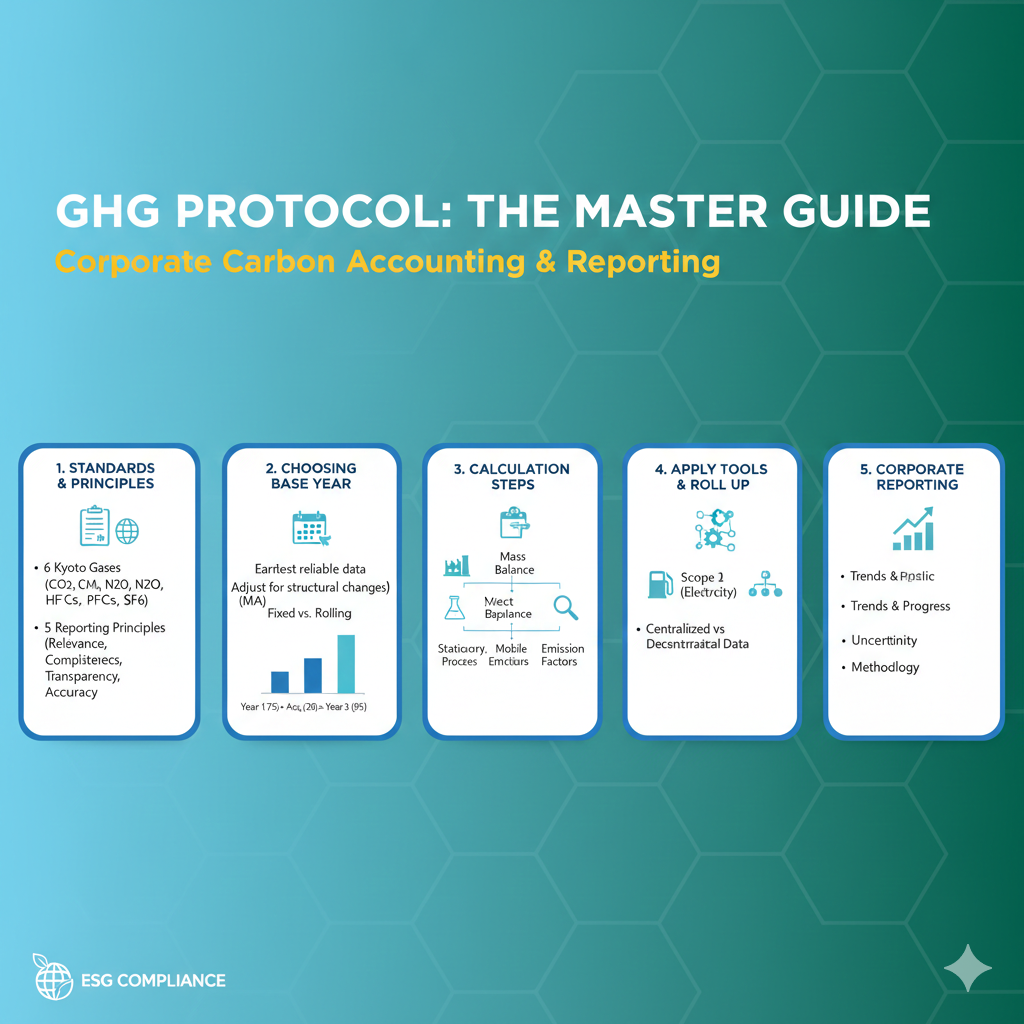
The Greenhouse Gas Protocol (GHG Protocol) provides the world’s most widely used strategic standards and guidance for companies and organizations to prepare a GHG inventory. It serves as a blueprint for identifying, calculating, and reporting the gases that contribute to global warming.
By following this standard, companies ensure that their climate claims are credible, comparable, and actionable.
The Six Greenhouse Gases
Under the Kyoto Protocol, six primary greenhouse gases must be accounted for in a corporate inventory. Each has a different Global Warming Potential (GWP):
- Carbon Dioxide (CO2): The primary byproduct of burning fossil fuels.
- Methane (CH4): Significant in agriculture and waste management.
- Nitrous Oxide (N2O): Often linked to industrial processes and fertilizer use.
- Hydrofluorocarbons (HFCs): Commonly found in refrigeration and air conditioning.
- Perfluorocarbons (PFCs): Resulting from aluminum production and semiconductor manufacturing.
- Sulphur Hexafluoride (SF6): Used primarily in electrical transmission and distribution equipment.
2. Core Principles of GHG Reporting
To ensure a high-quality inventory, the GHG Protocol mandates five core reporting principles. These act as the "Generally Accepted Accounting Principles" (GAAP) for the carbon world:
- Relevance: Ensure the GHG inventory appropriately reflects the emissions of the company and serves the decision-making needs of users.
- Completeness: Account for and report on all GHG emission sources and activities within the chosen inventory boundary.
- Consistency: Use consistent methodologies to allow for meaningful comparisons of emissions over time.
- Transparency: Address all relevant issues in a factual and coherent manner, based on a clear audit trail.
- Accuracy: Ensure that the quantification of GHG emissions is systematically neither over nor under actual emissions, as far as can be judged.
3. The Strategy of Base Year Selection
Because companies are dynamic—merging, acquiring, and divesting—establishing a base year is crucial for tracking performance over time.
How to Choose a Base Year
Companies typically choose a base year for which they have verifiable emissions data.
- Earliest Relevant Point: Choose the earliest year for which reliable data is available.
- Averaging: Some organizations use an average of several years (e.g., 2021–2023) to smooth out unusual fluctuations in production or climate.
Managing Structural Changes
Structural changes like mergers, acquisitions, outsourcing, or insourcing significantly impact emission data. To compare "apples to apples," companies must adjust their base year emissions when a significance threshold is met. This threshold is a qualitative or quantitative criterion used to define what constitutes a "significant" change to the data or inventory boundary.
Example of Base Year Adjustment: Imagine a company has two business units (A and B) emitting 25 and 50 tonnes of respectively (Total: 75). In Year 3, the company acquires Business Unit C, which emits 20 tonnes. To maintain a fair comparison, the base year must be updated to 95 tonnes. The same logic applies if a unit is divested.
4. Five Steps to Calculate GHG Emissions
Calculating your carbon footprint is a systematic process. Here is the roadmap recommended by the GHG Protocol:
Step 1: Identify GHG Emission Sources
Emission sources generally fall into four categories:
- Stationary Combustion: Burning fuels in stationary equipment like boilers, furnaces, and heaters.
- Mobile Combustion: Burning fuels in transport devices such as cars, trucks, and buses.
- Process Emissions: Emissions from physical or chemical processes (e.g., from cement manufacturing).
- Fugitive Emissions: Intentional or unintentional leaks, such as refrigerant leaks from AC joints or seals.
Step 2: Select a Calculation Approach
Direct monitoring (using sensors) is rare. Most companies use a calculation-based approach:
- Mass Balance/Stoichiometric Basis: Calculating emissions based on the chemical properties of the inputs and outputs of a process.
- Emission Factors: This is the most common method. You multiply activity data (like liters of fuel) by a documented Emission Factor (the ratio relating GHG emissions to a proxy measure of activity).
Step 3: Collect Activity Data and Choose Emission Factors
- Scope 1 (Direct): Calculated based on the purchase of commercial fuels (natural gas, diesel).
- Scope 2 (Indirect/Energy): Calculated based on metered electricity consumption and local grid emission factors.
- Scope 3 (Value Chain): Calculated from activity data like passenger miles, waste tonnage, or fuel use from third-party logistics.
Step 4: Apply Calculation Tools
The GHG Protocol offers various sector-specific and cross-sector tools. These automated templates help ensure that the math behind your inventory aligns with international standards (such as the IPCC 1996 guidelines).
Step 5: Roll Up Data to the Corporate Level
Once the data is collected, it must be consolidated. There are two primary approaches:
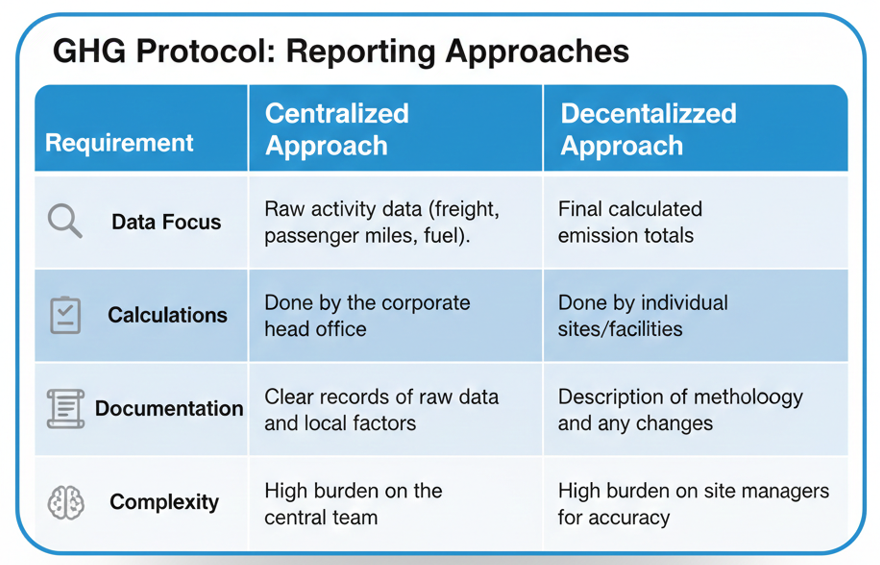
- Centralized: Individual sites report raw activity data (fuel bills, meter readings), and a central corporate team performs all calculations.
- Decentralized: Individual sites calculate their own emissions and report the final totals to the headquarters.
5. Best Practices for Corporate Reporting
A high-quality GHG report is more than just a number; it is a narrative of the company's environmental impact. Your final report should include:
- Detailed Descriptions: A brief overview of the emissions and a list of justifications for any excluded sources.
- Trend Analysis: Comparative information from previous years and an explanation of evident trends.
- Progress Tracking: How the company is performing against its specific business targets.
- Uncertainty Discussion: A transparent look at the reliability of activity data and recommendations for future improvement.
- Methodology: A clear record of calculations and local emission factors used.
Summary Table: Centralized vs. Decentralized Reporting
Conclusion
Adopting the GHG Protocol Standard is no longer just about compliance—it's about building a resilient, future-proof business. By establishing a solid base year, identifying all emission sources, and applying rigorous calculation tools, your organization can move from simply measuring its footprint to actively reducing it.
💌 Enjoyed this article?
If you found this post valuable, subscribe to my newsletter for more insights on digital transformation, AI, and business innovation.
👉 Subscribe to the newsletterOr let’s connect on LinkedIn — I share weekly content that’s practical for CIOs, CFOs, and transformation leaders.
🔗 Connect with me on LinkedIn