Navigating the Blue Frontier: The Rise of Carbon Removal in the Maritime Industry
2026-01-29 · By Anil Kancharla · 5 min read
❤️ 0 Likes · 👁️ 0 Views
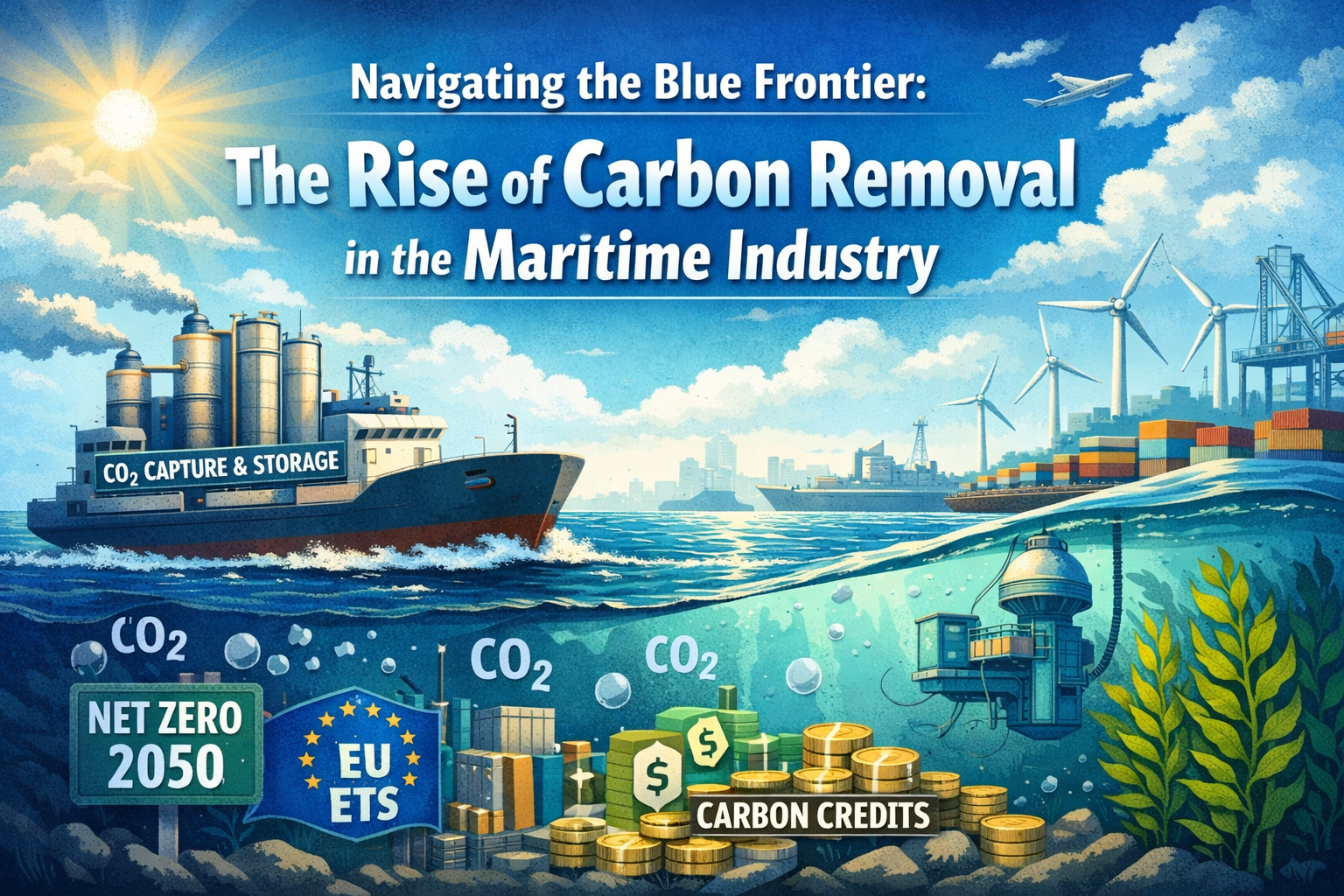 AI-generated image for illustration purposes only.
Navigating the Blue Frontier: The Rise of Carbon Removal in the Maritime Industry
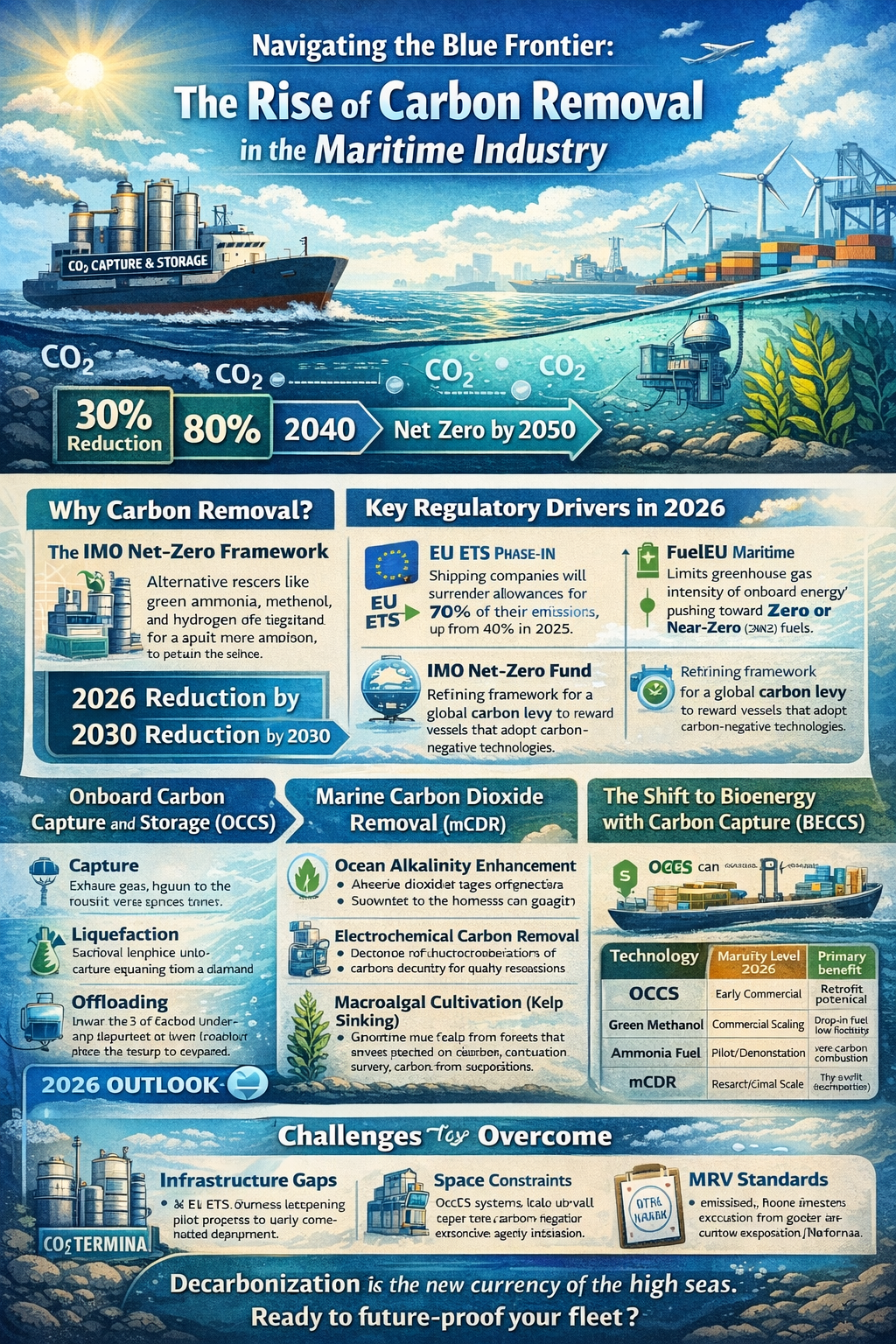 AI-generated image for illustration purposes only.
Navigating the Blue Frontier: The Rise of Carbon Removal in the Maritime Industry
The maritime industry is standing at a historical crossroads. For decades, the high seas have been the backbone of global trade, but today, they are the frontline of the climate transition. As we move through 2026, the conversation has shifted from simple "emission reduction" to a much more ambitious goal: Carbon Removal.
With the International Maritime Organization (IMO) targeting net-zero emissions by or around 2050, and the EU Emissions Trading System (ETS) now in full swing for shipping, "business as usual" is no longer an option. This blog explores the cutting-edge technologies, regulatory shifts, and economic incentives driving maritime carbon removal and why it is the key to a sustainable blue economy.
Why Carbon Removal? The IMO Net-Zero Framework
The shipping sector is responsible for nearly 3% of global greenhouse gas (GHG) emissions. While alternative fuels like green ammonia, methanol, and hydrogen are making waves, they only solve part of the equation. To reach the IMO's "indicative checkpoints" of a 30% reduction by 2030 and 80% by 2040, we need to actively remove CO₂ from the atmosphere and the oceans.
Key Regulatory Drivers in 2026:
- EU ETS Phase-In: As of 2026, shipping companies must surrender allowances for 70% of their reported emissions, up from 40% in 2025.
- FuelEU Maritime: This regulation now imposes strict limits on the greenhouse gas intensity of energy used on board, pushing the industry toward Zero or Near-Zero (ZNZ) fuels.
- IMO Net-Zero Fund: Although global legal adoption has seen debates, the framework for a global carbon levy is being refined, with rewards planned for vessels that adopt carbon-negative technologies.
1. Onboard Carbon Capture and Storage (OCCS)
One of the most practical near-term solutions is Onboard Carbon Capture and Storage (OCCS). Instead of switching engines entirely, OCCS allows existing vessels to capture CO₂ directly from exhaust gases before they reach the atmosphere.
How it Works:
- Capture: Exhaust gas is passed through a chemical solvent (like amines) or a membrane that binds with CO₂.
- Liquefaction: The captured carbon is cooled and compressed into a liquid state.
- Storage: Liquid CO₂ is stored in specialized tanks on deck or within the hull.
- Offloading: Once the ship reaches a port, the CO₂ is transferred to storage hubs or used in industrial processes (CCUS).
The 2026 Outlook: OCCS is moving from pilot projects to early commercial deployment. Shipyards are now offering "CCS-ready" vessel designs, allowing owners to future-proof their fleets.
2. Marine Carbon Dioxide Removal (mCDR)
While OCCS stops new emissions, Marine Carbon Dioxide Removal (mCDR) leverages the ocean's natural ability to act as a carbon sink. This is where the maritime industry transitions from a "polluter" to a "protector."
Leading mCDR Pathways:
- Ocean Alkalinity Enhancement (OAE): Adding alkaline minerals (like lime or olivine) to seawater to increase its CO₂ absorption capacity and combat ocean acidification.
- Electrochemical Carbon Removal: Using specialized equipment to "scrub" CO₂ directly from seawater, which then allows the water to pull more carbon from the air.
- Macroalgal Cultivation (Kelp Sinking): Growing massive kelp forests that absorb carbon and then sinking the biomass to the deep ocean floor for permanent sequestration.
3. The Shift to Bioenergy with Carbon Capture (BECCS)
In 2026, biogenic carbon removal is emerging as a top-tier strategy. By using biofuels (derived from sustainable biomass) in combination with OCCS, a ship can actually become carbon negative. This means the vessel removes more carbon from the cycle than it emits, creating high-value carbon removal credits that can be traded on global markets.
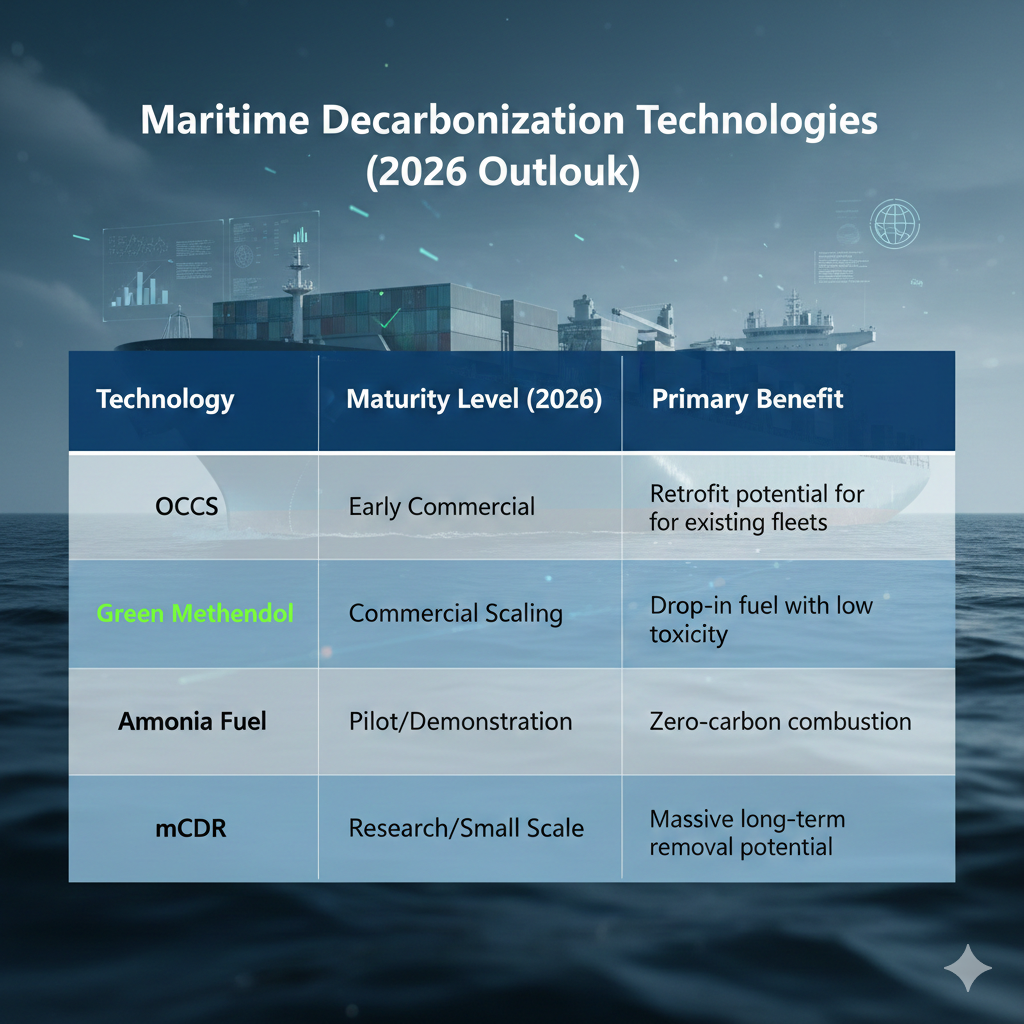 AI-generated image for illustration purposes only.
The Economics: Is it Profitable?
The biggest hurdle has always been the cost per ton of CO₂ captured. However, the tide is turning.
- Carbon Pricing: With EU ETS prices fluctuating between €80 and €100 per ton, the "penalty" for emitting is becoming more expensive than the "cost" of capturing.
- Green Corridors: Major ports (like Singapore, Rotterdam, and Los Angeles) are establishing Green Shipping Corridors, offering discounted port fees and bunkering priorities for "green" vessels.
- Corporate Demand: Global brands (Amazon, IKEA, Patagonia) are now demanding zero-emission supply chains, allowing shipowners to command a "green premium" for their services.
Challenges to Overcome
Despite the momentum, 2026 presents several challenges:
- Infrastructure Gaps: We need more "CO₂ receiving terminals" at ports to handle captured carbon.
- Space Constraints: OCCS systems take up valuable cargo space and require significant energy to run.
- MRV Standards: Measurement, Reporting, and Verification (MRV) protocols must be standardized to ensure that one ton of "removed" carbon is scientifically accurate.
Conclusion: Setting Sail for a Net-Zero Future
The maritime industry is no longer just about moving goods; it's about moving toward a sustainable future. Whether through Onboard Carbon Capture, Marine CDR, or the adoption of SZEFs (Scalable Zero-Emission Fuels), the leaders of tomorrow are those investing in carbon removal today.
The transition is complex, but the message is clear: Decarbonization is the new currency of the high seas.
💌 Enjoyed this article?
If you found this post valuable, subscribe to my newsletter for more insights on digital transformation, AI, and business innovation.
👉 Subscribe to the newsletterOr let’s connect on LinkedIn — I share weekly content that’s practical for CIOs, CFOs, and transformation leaders.
🔗 Connect with me on LinkedIn