Systems Thinking 101: Why You Can’t Solve Emissions in a Silo
2026-01-08 · By Anil Kancharla · 7 min read
❤️ 0 Likes · 👁️ 0 Views
 AI-generated image for illustration purposes only.
Systems Thinking 101: Why You Can’t Solve Emissions in a Silo
 AI-generated image for illustration purposes only.
Systems Thinking 101: Why You Can’t Solve Emissions in a Silo
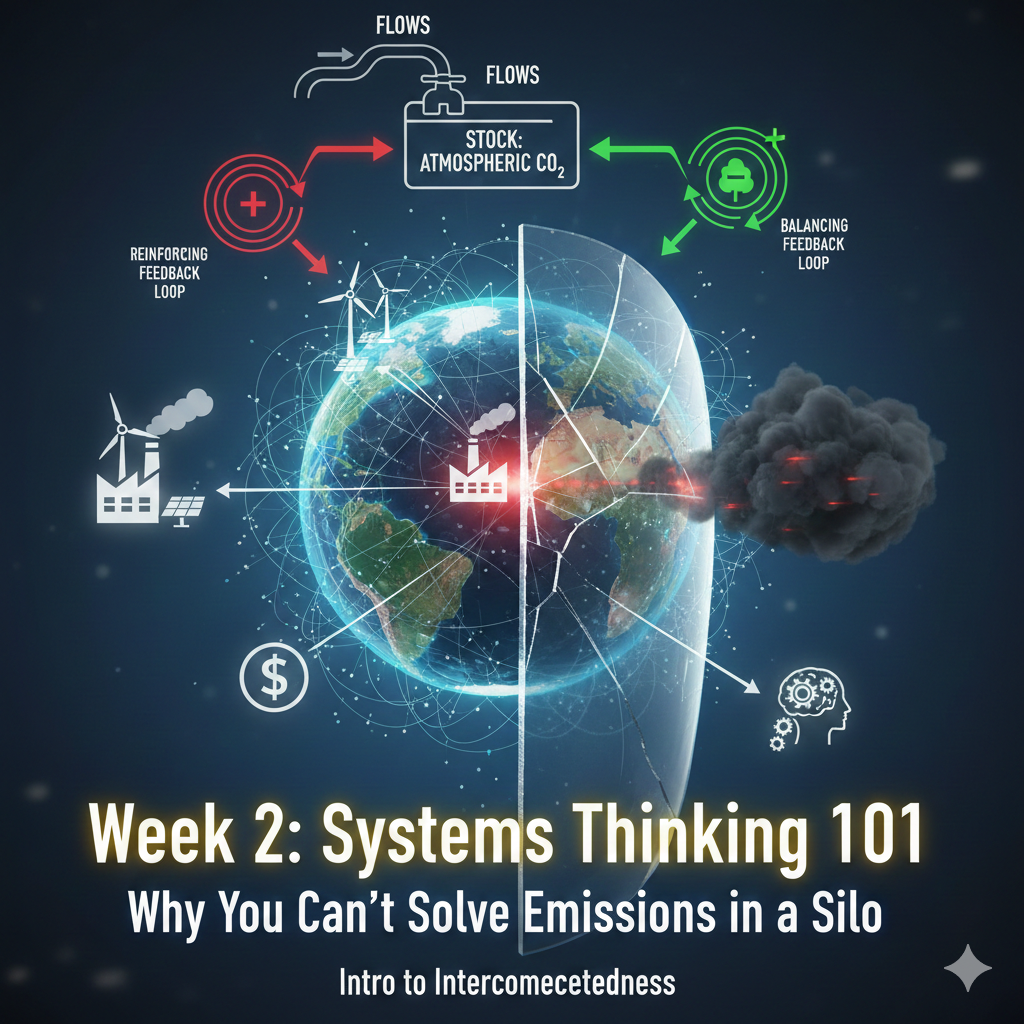
As Albert Einstein once famously noted, "The goal of all theory is to make the basic elements as simple and as few as possible without having to surrender the adequate representation of experience." When we apply this to the climate crisis, we often make the mistake of oversimplifying. We treat carbon emissions as a "math problem" to be solved by swapping one fuel for another. But carbon emissions aren't a standalone variable; they are the output of a massive, interconnected global system. If you try to solve emissions in a silo, you aren't just fighting physics—you’re fighting the very nature of systems.
Welcome to Systems Thinking 101. This week, we explore why understanding the "whole" is the only way to fix the "parts."
 AI-generated image for illustration purposes only.
What is a System? (The Anatomy of the Whole)
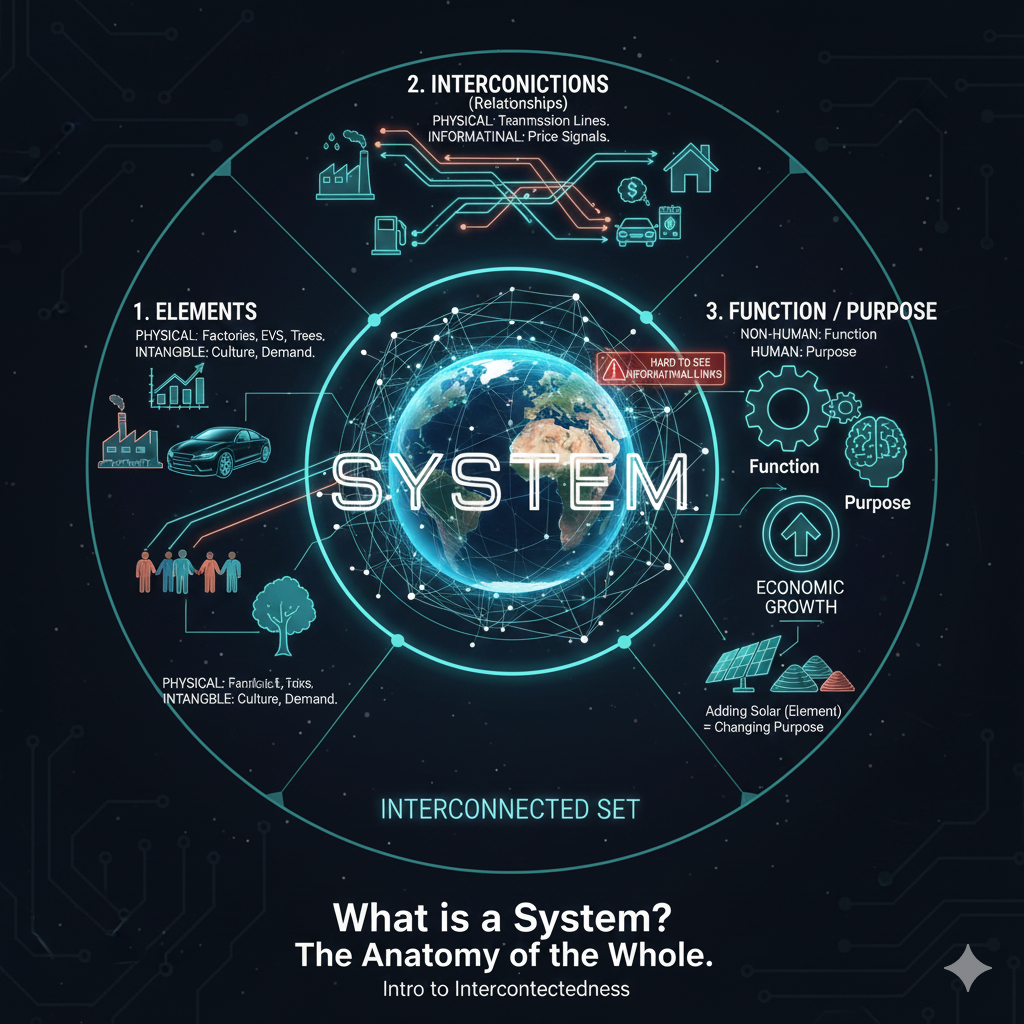
A system is more than just a collection of things. It is an interconnected set of elements coherently organized to achieve a specific purpose or function. To understand why emissions are so "sticky," we have to look at the three pillars of any system:
1. Elements
These are the easiest parts to identify. They can be physical (factories, electric vehicles, trees) or intangible (corporate culture, consumer demand). While elements are visible, they are often the least impactful place to start a change. For example, if you replace every player on a football team, it is still a football team. Changing the elements alone rarely changes the system's behavior.
2. Interconnections (Relationships)
This is where the magic—and the mess—happens. Interconnections are the relationships between elements. They can be physical (transmission lines connecting a power plant to a home) or informational (the price of gas influencing a person's decision to buy a car).
The Challenge: Informational relationships are incredibly hard to identify, yet they often dictate the system’s direction more than the physical hardware.
3. Function or Purpose
The "non-human" part of a system has a function, while the "human" part has a purpose. This is the primary objective. If a system's purpose is "economic growth at all costs," adding solar panels (elements) won't stop resource depletion because the underlying purpose remains unchanged.
Stocks, Flows, and the Carbon Bathtub
 AI-generated image for illustration purposes only.
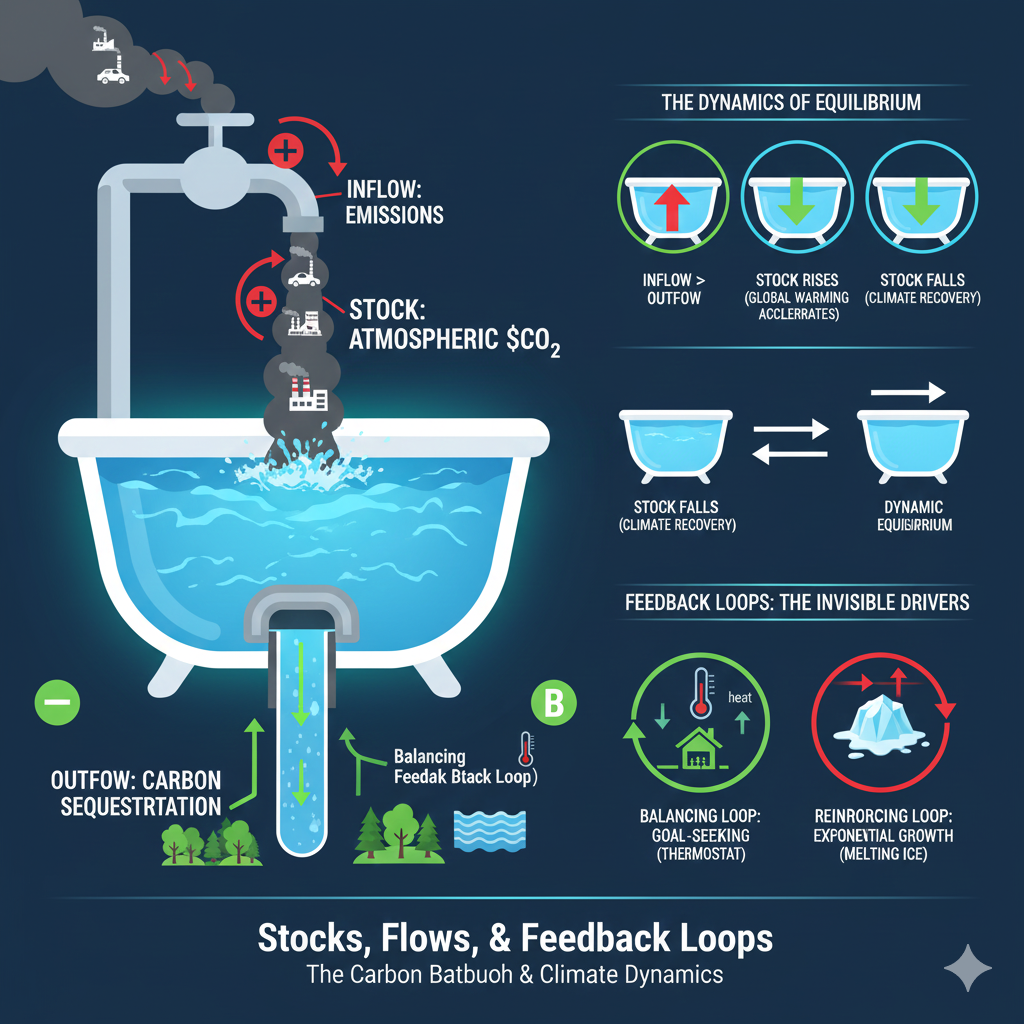
To visualize systems, we use a specific language: Stocks and Flows.
- Stocks: These are the elements you can see, feel, count, or measure at any given time (e.g., the amount of currently in the atmosphere). A stock is essentially the "memory" of a system's history.
- Flows: These are the inputs and outputs (e.g., emissions going up, carbon sequestration coming down).
Think of the Earth's atmosphere as a bathtub. The water in the tub is the Stock. The faucet is the Inflow (emissions), and the drain is the Outflow (natural carbon sinks like forests and oceans).
The Dynamics of Equilibrium
- Inflow > Outflow: The Stock rises (Global warming accelerates).
- Inflow < Outflow: The Stock falls (Climate recovery).
- Inflow = Outflow: Dynamic Equilibrium (The level stays the same, even though water is still moving through the tub).
The Systems Insight: Most people focus only on "turning off the tap" (reducing inflows). However, system thinkers know you can also manage a stock by "clearing the drain" (increasing outflows/sequestration). Furthermore, stocks act as buffers or shocks absorbers. Because is a "heavy" stock, it changes slowly. This is a double-edged sword: it gives us a delay to maneuver, but it also means the system has massive momentum that won't stop the moment we hit "net zero."
Feedback Loops: The Invisible Drivers
Systems are governed by Feedback Loops—closed chains of causal connections that tell the system how to react to changes in a stock.
Balancing Feedback Loops (B)
These are goal-seeking structures that provide stability. Think of a thermostat. When it gets too cold, the heat kicks on to bring the temperature back to a range. In climate terms, some natural weathering processes act as balancing loops, but they are often too slow for our current rate of change.
Reinforcing Feedback Loops (R)
These are the "runaway" loops that lead to exponential growth or collapse. A classic example is the melting of Arctic ice: less ice means less sunlight reflected, which leads to more heat absorption, which leads to more ice melting.
Reinforcing loops are found whenever a stock has the capacity to reproduce or reinforce itself.
Why Systems Surprise Us: Delays and Bounded Rationality
If systems were simple, we would have solved the emissions crisis decades ago. They surprise us because of:
- Delays: Information in a feedback loop only affects future behavior, not current behavior. This "time lag" is why we often over-correct or give up too soon.
- Non-Linearity: In a system, doesn't always lead to in a straight line. Small changes can trigger massive, exponential shifts.
- Bounded Rationality: People make "reasonable" decisions based on the information they have, but no one has "perfect" information about the whole system. A CEO might make a "rational" choice for their company that is "irrational" for the planet’s survival.
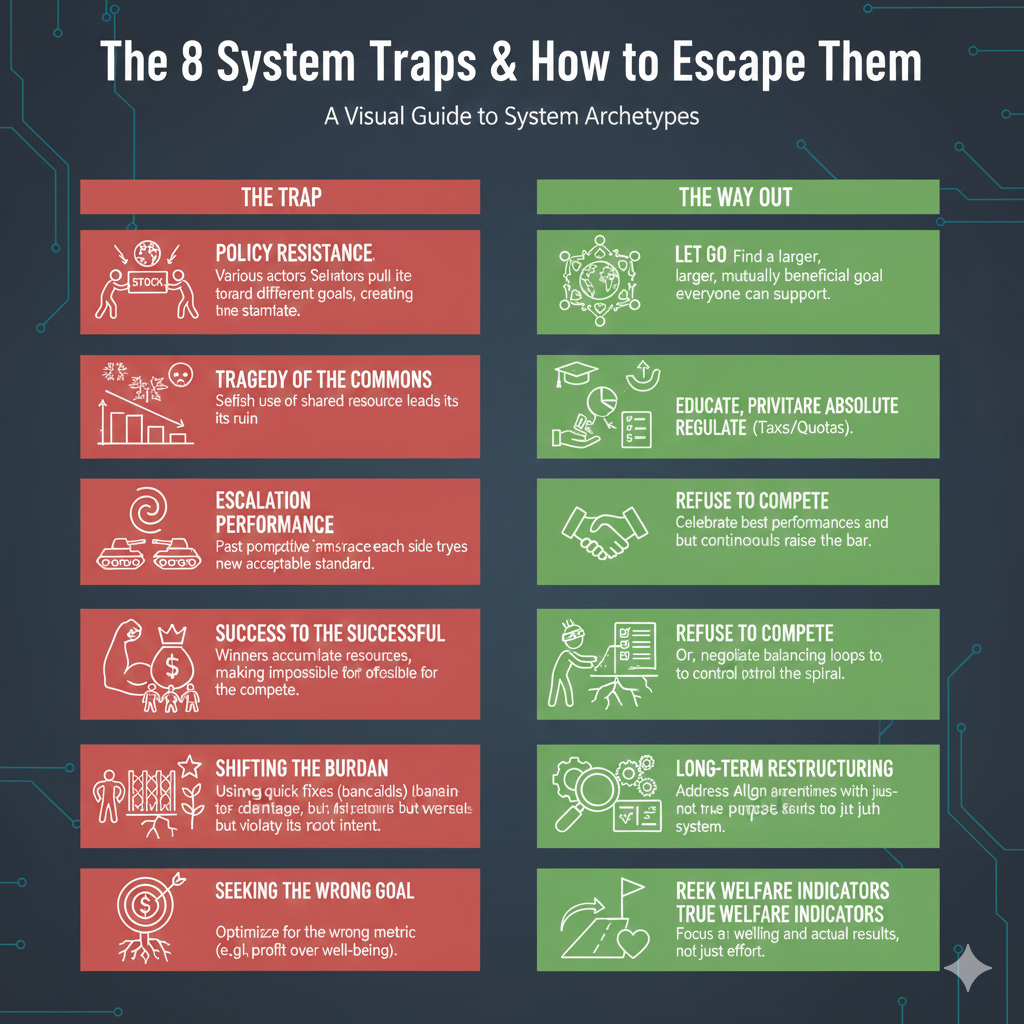
The 8 System Traps (and How to Escape Them)
When systems produce unintended results, they are often caught in "Archetypes" or traps. Recognizing these is the first step to solving siloed thinking.
 AI-generated image for illustration purposes only.
Where to Intervene: The 12 Leverage Points
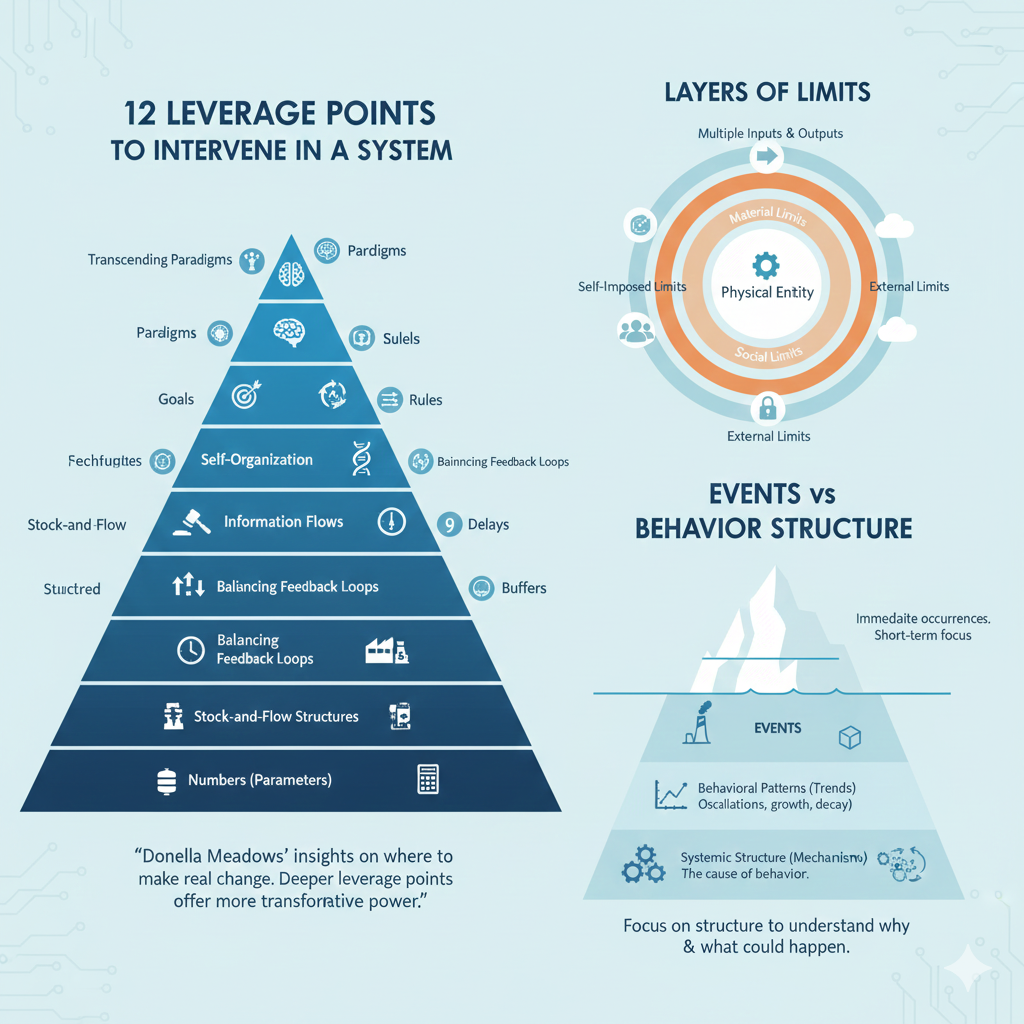
Not all changes are created equal. Donella Meadows, a pioneer in systems thinking, identified 12 places to intervene. The further down the list you go, the more power you have to transform the system.
- Numbers (Least Impact): Changing tax rates or subsidies.
- Buffers: Changing the size of stocks.
- Stock-and-Flow Structures: Changing physical infrastructure.
- Delays: Reducing the time it takes for information to flow.
- Balancing Loops: Strengthening the "self-correction" mechanisms.
- Reinforcing Loops: Slowing down the "runaway" processes.
- Information Flows: Giving people access to data they didn't have before.
- Rules: Changing incentives and punishments.
- Self-Organization: Encouraging the system to evolve its own new structures.
- Goals: Changing the purpose of the system (e.g., from "Growth" to "Sustainability").
- Paradigms: The mindset out of which the system arises.
- Transcending Paradigms (Most Impact): Realizing that no one paradigm is "the truth."
Conclusion: Designing for Resilience
Highly functional systems share three traits: Resilience (the ability to bounce back), Self-Organization (the ability to evolve), and Hierarchy (the organization of subsystems into a whole).
To solve emissions, we cannot simply look at a carbon tally. We must manage the system for resilience, not just productivity. We must allow for the "disorder" of self-organization and experimentation. And we must ensure that our subsystems (industries, nations, cities) aren't "sub-optimizing"—achieving their own goals at the expense of the global system.
The climate isn't a siloed problem; it's a systemic behavior. If we want to change the behavior, we have to change the structure.
💌 Enjoyed this article?
If you found this post valuable, subscribe to my newsletter for more insights on digital transformation, AI, and business innovation.
👉 Subscribe to the newsletterOr let’s connect on LinkedIn — I share weekly content that’s practical for CIOs, CFOs, and transformation leaders.
🔗 Connect with me on LinkedIn