Navigating the Carbon Landscape: A Beginner’s Guide to Scope 1, 2, and 3 Emissions
2026-02-04 · By Anil Kancharla · 6 min read
❤️ 0 Likes · 👁️ 0 Views
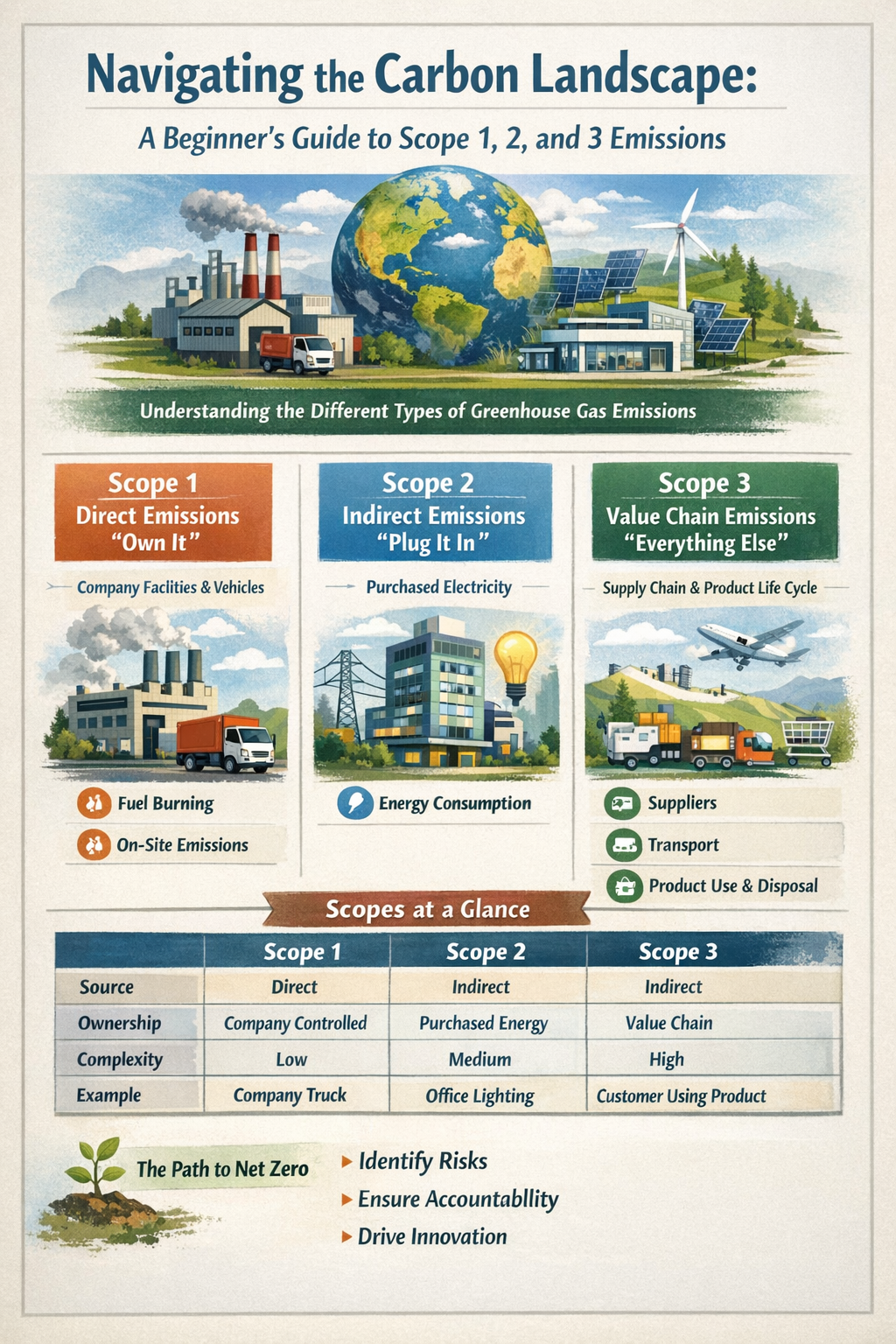 AI-generated image for illustration purposes only.
Navigating the Carbon Landscape: A Beginner’s Guide to Scope 1, 2, and 3 Emissions
In the modern business world, "sustainability" is no longer just a buzzword found in annual reports—it’s a global mandate. As climate change takes center stage, companies, investors, and consumers are looking closer at Carbon Footprints.
If you’ve dipped your toes into environmental science or corporate responsibility, you’ve likely encountered the terms Scope 1, 2, and 3 emissions. While they might sound like technical jargon from a lab, they are actually a very simple way of categorizing where greenhouse gases (GHG) come from.
In this guide, we’ll break down these three categories into plain English so you can understand how organizations measure their impact on the planet.
What is the GHG Protocol?
Before we dive into the scopes, we need to mention the Greenhouse Gas Protocol. Established in the late '90s, it is the world’s most widely used greenhouse gas accounting standard. It created these three "scopes" to help companies avoid double-counting emissions and to provide a comprehensive view of their environmental impact.
Scope 1: Direct Emissions (The "Own It" Category)
Scope 1 emissions are the most straightforward. These are direct emissions from sources that are owned or controlled by the company.
Think of Scope 1 as anything where the company is physically "burning" something or releasing gas directly into the atmosphere on-site.
Key Examples of Scope 1:
- Stationary Combustion: Burning fuels like natural gas or heating oil in company boilers or furnaces.
- Mobile Combustion: The gasoline or diesel burned by a fleet of company-owned cars, trucks, or delivery vans.
- Fugitive Emissions: Accidental leaks, such as hydrofluorocarbons (HFCs) from air conditioning units or refrigeration systems.
- Process Emissions: CO2 released during specific industrial processes, like the chemical transformation involved in making cement.
The Bottom Line: If the company owns the tailpipe or the smokestack, it’s Scope 1.
Scope 2: Indirect Emissions (The "Plug It In" Category)
Scope 2 emissions are indirect emissions from the generation of purchased energy.
While the company isn't burning the fuel themselves, they are using energy that required someone else to burn fuel. The most common example here is electricity. When you flip a light switch in an office, the emissions are created at the power plant, not in the office—but the office is responsible for that consumption.
Key Examples of Scope 2:
- Purchased Electricity: The "grid" power used to run computers, lights, and machinery.
- District Heating/Cooling: Steam or chilled water purchased from a utility provider to regulate building temperatures.
The Bottom Line: If you buy energy from a utility company to power your business, it’s Scope 2.
Scope 3: Value Chain Emissions (The "Everything Else" Category)
Scope 3 emissions are often the most complex and the most significant. These are all the other indirect emissions that occur in a company’s value chain. This includes both "upstream" (what it takes to make your product) and "downstream" (what happens after you sell it).
For many companies, Scope 3 accounts for more than 70% of their total carbon footprint.
Upstream Scope 3 (Before the product reaches you):
- Purchased Goods and Services: The carbon cost of extracting raw materials (like mining for smartphone metals).
- Business Travel: Employees flying for meetings or taking trains.
- Employee Commuting: How your staff gets to work every day.
- Waste Generated: Emissions from trash that ends up in a landfill.
Downstream Scope 3 (After the product leaves you):
- Use of Sold Products: Think of a car manufacturer; the emissions the car produces while a customer drives it are the manufacturer's Scope 3 emissions.
- End-of-Life Treatment: What happens when a product is thrown away or recycled?
- Investments: For banks and VC firms, the emissions of the companies they fund fall into this category.
The Bottom Line: If it’s related to your business but happens outside your direct control, it’s Scope 3.
Scope 1, 2, and 3 at a Glance
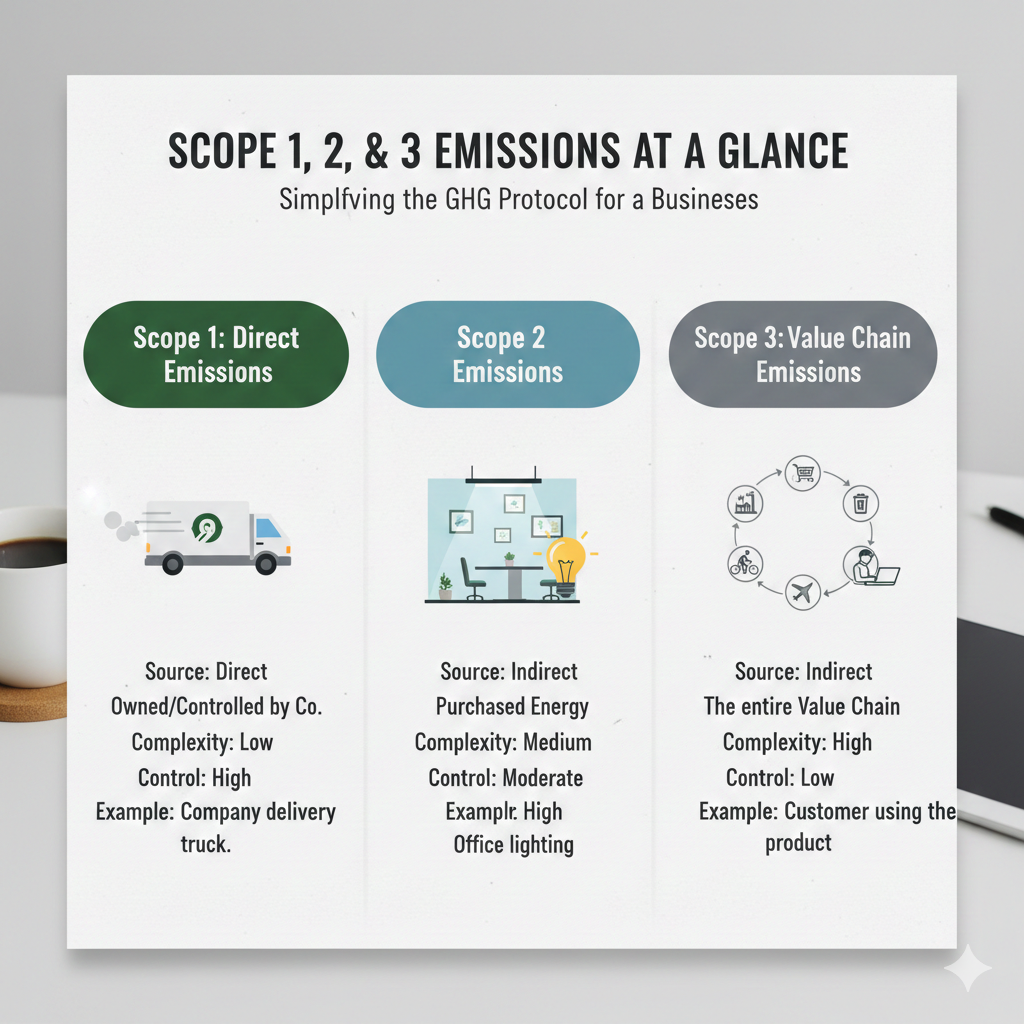 AI-generated image for illustration purposes only.
Why Should We Care About the Scopes?
You might wonder why we bother separating these. Why not just measure "total carbon"? The distinction is vital for three main reasons:
1. Identifying Risk
If a company only looks at Scope 1, they might think they are "green." However, if their entire supply chain (Scope 3) relies on heavy-polluting factories in other countries, they are at high risk for future carbon taxes or supply chain disruptions.
2. Accountability and Transparency
By using these standard definitions, companies can’t "hide" their emissions. If a tech company claims to be "Carbon Neutral" but only measures their office (Scope 1 and 2) while ignoring the massive energy used by their data centers or the mining of minerals for their hardware (Scope 3), the public can hold them accountable.
3. Finding Opportunities for Innovation
When a company maps out its Scope 3 emissions, it often discovers massive inefficiencies. For example, a clothing brand might realize that 80% of its emissions come from a specific dyeing process. This encourages them to switch to waterless dyeing technologies, saving both money and the planet.
Common Misconceptions
- "Scope 3 is optional": While it used to be considered "extra credit," new regulations (like those in the EU and California) are increasingly making Scope 3 reporting mandatory for large corporations.
- "Double counting is bad": In the GHG Protocol, double counting is actually built-in. Your Scope 1 (the gas you burn in your truck) is someone else’s Scope 3 (the company that hired you to deliver a package). This ensures that someone is always responsible for every ton of CO2.
Summary: The Path to Net Zero
Understanding Scope 1, 2, and 3 is the first step on the journey toward Net Zero. You cannot manage what you do not measure. By categorizing emissions this way, businesses can create a roadmap to reduce their direct impact first, transition to renewable energy second, and finally, work with partners to clean up the entire global supply chain.
Whether you are a business owner or a conscious consumer, knowing these terms helps you see through "greenwashing" and understand the real work required to protect our climate.
💌 Enjoyed this article?
If you found this post valuable, subscribe to my newsletter for more insights on digital transformation, AI, and business innovation.
👉 Subscribe to the newsletterOr let’s connect on LinkedIn — I share weekly content that’s practical for CIOs, CFOs, and transformation leaders.
🔗 Connect with me on LinkedIn