The Digital Mandate: How Public Administration is Reinventing Governance with ERP Software
2025-12-03 · By Anil Kancharla · 7 min read
❤️ 0 Likes · 👁️ 0 Views
 AI-generated image for illustration purposes only.
The Digital Mandate: How Public Administration is Reinventing Governance with ERP Software
 AI-generated image for illustration purposes only.
The Digital Mandate: How Public Administration is Reinventing Governance with ERP Software
The social contract between the government and the governed is being rewritten by technology. For decades, the public sector operated on a model defined by paper forms, long lines, and siloed departments that rarely spoke to one another. Today, that model is crumbling under the weight of modern expectations.
Citizens who can order a car, pay a bill, or file an insurance claim on their phone in seconds now expect the same level of speed, transparency, and convenience from their public institutions. Whether it is a local municipality, a state agency, or a national department, the mandate is clear: modernize or risk losing the public’s trust.
We are entering the era of "Smart Governance." This transformation goes far beyond simply scanning documents or creating a website. It requires a fundamental restructuring of how the public sector operates, manages resources, and delivers value. At the core of this revolution—serving as the digital backbone of the modern administration—is Enterprise Resource Planning (ERP) software.
This in-depth blog post will explore the complex landscape of Public Administration, uncover the immense opportunities of its digital evolution, and provide a comparative analysis of leading ERP solutions designed to help governments serve their constituents in the digital age.
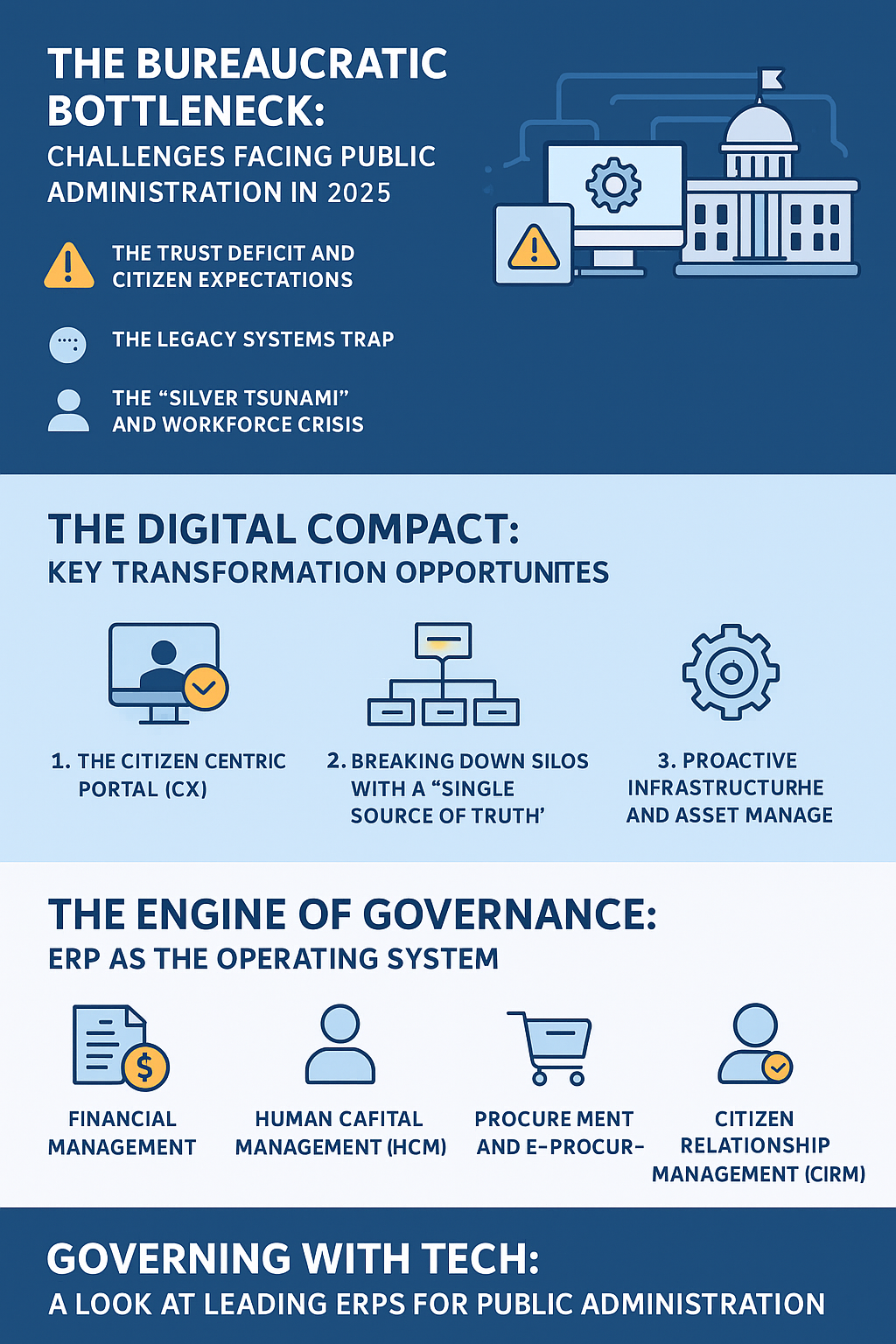
The Bureaucratic Bottleneck: Challenges Facing Public Administration in 2025
While the private sector chases profit, the public sector chases the "public good." However, achieving that goal is becoming increasingly difficult due to a convergence of structural and operational challenges.
- The Trust Deficit and Citizen Expectations: We live in an on-demand world. When a citizen applies for a permit, pays a tax, or requests a service, they expect real-time updates and digital interfaces. The "black box" of government bureaucracy—where applications disappear for weeks without a trace—is no longer acceptable.
- The Legacy Systems Trap: Many public agencies are still running on mainframes and software code written in the 1980s or 90s. These legacy systems are expensive to maintain, vulnerable to cyberattacks, and incapable of sharing data with modern applications. This creates "data silos" where the finance department doesn't know what the HR department is doing, and neither has visibility into procurement.
- The "Silver Tsunami" and Workforce Crisis: The public sector is facing a severe talent shortage. A significant portion of the workforce is reaching retirement age (the "silver tsunami"), taking decades of institutional knowledge with them. Simultaneously, agencies struggle to attract younger, tech-savvy talent who are deterred by antiquated tools and rigid hierarchies.
- Fiscal Accountability and Grant Management: Public funds must be managed with absolute precision. Agencies are under constant scrutiny to prove that tax dollars and federal grants are being used effectively. Managing complex "fund accounting," grant compliance, and budget transparency on spreadsheets is a recipe for error and audit failure.
- Cybersecurity Threats: Governments hold the most sensitive data of all—from social security numbers to health records. They are prime targets for ransomware and state-sponsored cyberattacks. Protecting this data infrastructure is a matter of national security.
The Digital Compact: Key Transformation Opportunities
Digital transformation offers a pathway out of these bottlenecks. By adopting a modern digital core, public administrations can move from reactive bureaucracy to proactive service delivery.
1. The Citizen-Centric Portal (CX)
The most visible aspect of transformation is the shift from "in-line" to "online."
- The Opportunity: A unified ERP connected to a web portal allows citizens to access a "Single Window" for all services. Instead of visiting the tax office, the zoning board, and the clerk separately, a constituent can log in once to pay property taxes, renew a license, and report a pothole. This not only improves satisfaction but dramatically reduces the administrative burden on front-line staff.
2. Breaking Down Silos with a "Single Source of Truth"
In the past, the Police Department, the Department of Public Works, and the School Board might have operated as separate fiefdoms with separate databases.
- The Opportunity: A modern ERP integrates these functions. When a budget is approved in the finance module, it is instantly visible to the procurement team. When an employee is hired in HR, their payroll and benefits are automatically set up in Finance. This integration eliminates duplicate data entry, reduces errors, and speeds up decision-making.
3. Proactive Infrastructure and Asset Management
Governments manage billions of dollars in assets, from fleets of police cruisers to wastewater treatment plants and miles of roadway.
- The Opportunity: Integrating IoT (Internet of Things) sensors with the ERP’s Asset Management module allows for Predictive Maintenance. Instead of waiting for a bridge to show signs of stress or a water pump to fail, the system analyzes sensor data to schedule maintenance before a failure occurs. This extends the life of public assets and saves millions in emergency repairs.
4. Radical Financial Transparency and Grant Management
Trust is built on transparency. Modern ERPs are designed for the unique complexity of public sector finance, specifically Fund Accounting.
- The Opportunity: Agencies can track every dollar from a specific federal grant through to its final expenditure in real-time. Automated reporting tools can generate "Open Data" dashboards that allow the public to see exactly how their tax money is being spent, fostering accountability and trust.
5. Data-Driven Policy Making
Governments have historically been data-rich but insight-poor.
- The Opportunity: By applying AI and analytics to the data stored in the ERP, administrators can uncover trends that inform better policy. For example, analyzing procurement data might reveal that consolidating purchases across three different agencies could save 15% on office supplies. Analyzing HR data might reveal patterns in overtime usage that suggest a need for staffing adjustments.
The Engine of Governance: ERP as the Operating System
To realize these opportunities, an agency cannot rely on a patchwork of disconnected apps. It needs a central nervous system. This is the role of Enterprise Resource Planning (ERP) software designed for the public sector.
Unlike a corporate ERP focused on profit margins, a Public Sector ERP focuses on Budgetary Control and Service Delivery. It integrates the core pillars of government operations:
- Financial Management: Handling complex fund accounting, encumbrance accounting (committing funds before they are spent), and Comprehensive Annual Financial Reports (CAFR).
- Human Capital Management (HCM): Managing the complete lifecycle of civil servants, from recruitment and complex union-negotiated payrolls to benefits administration and pension management.
- Procurement and e-Procurement: managing the public bidding process, vendor management, and contract compliance to ensure fair competition and best value.
- Citizen Relationship Management (CiRM): The government equivalent of CRM, tracking interactions with constituents to ensure requests are handled promptly.
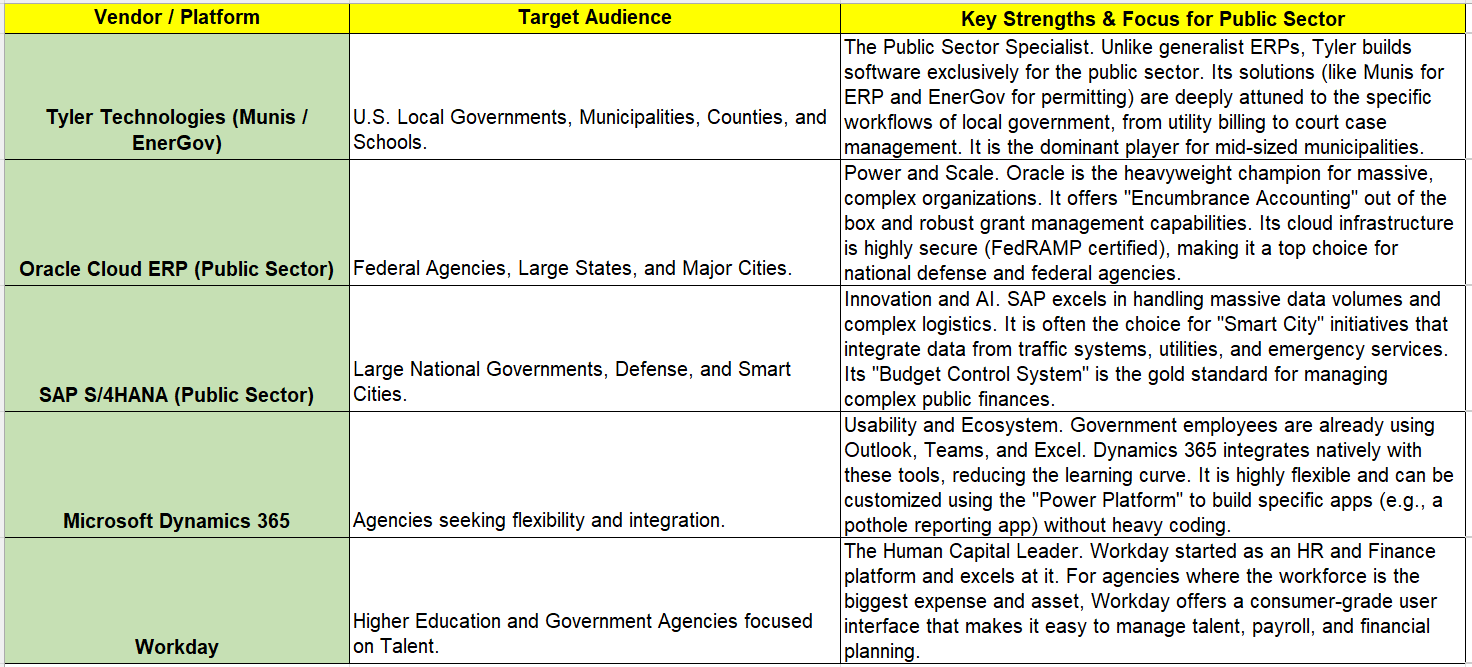
Governing with Tech: A Look at Leading ERPs for Public Administration
The market includes global enterprise giants and specialized providers who understand the unique regulatory environment of the public sector.
The Future of the Public Square
The future of public administration is not about smaller government or larger government; it is about smarter government. It is about an administration that uses data to anticipate the needs of its vulnerable populations, uses automation to stretch limited tax dollars further, and uses digital platforms to listen to and serve its constituents with dignity and speed.
This future is being built today, code by code and module by module. By retiring the legacy systems of the past and embracing a modern, integrated ERP strategy, public administrators are not just upgrading their software; they are upgrading the very infrastructure of democracy for the digital age.
💌 Enjoyed this article?
If you found this post valuable, subscribe to my newsletter for more insights on digital transformation, AI, and business innovation.
👉 Subscribe to the newsletterOr let’s connect on LinkedIn — I share weekly content that’s practical for CIOs, CFOs, and transformation leaders.
🔗 Connect with me on LinkedIn